-> Interviewed and blogged by GPT. Nice job, AI! 🤖
I arrived in Vancouver with my wife, my cat, my dog, and a nervous system that seemed permanently stuck on high alert.
Technically, I was not starting over.
I had already worked as a software engineer in China. I knew how to write code, solve technical problems, collaborate with a team, and survive complicated projects.
But when I entered a Canadian workplace for the first time, it felt as though I had to learn my career all over again.
Same profession. Different language. Different expectations. Different world.

I Did Not Arrive Calmly
I moved to Vancouver about three years ago, after a difficult period during the COVID lockdowns in China.
I arrived hoping for a life that felt calmer and more stable, but emotionally I was still carrying a great deal of stress and uncertainty.
That meant I did not enter my new office as a relaxed, confident engineer.
I entered as someone who was afraid of making the wrong move.
My spoken English was not strong. I did not know how Canadian colleagues built friendships. I was unsure how formal I should be, how often I should speak, when I should ask questions, or how people expected me to communicate.
Even an ordinary conversation could feel like a technical interview for a programming language I had never studied.
The Same Job Can Run on a Different Operating System
Software engineering can look universal from the outside.
There are tickets, meetings, bugs, deadlines, code reviews, and technical decisions everywhere.
But the social operating system underneath the work can be completely different.
In China, I had learned to pay attention to hierarchy, context, tone, and unspoken expectations. Sometimes the official instruction was only part of the real instruction.
So naturally, I assumed my new workplace might operate the same way.
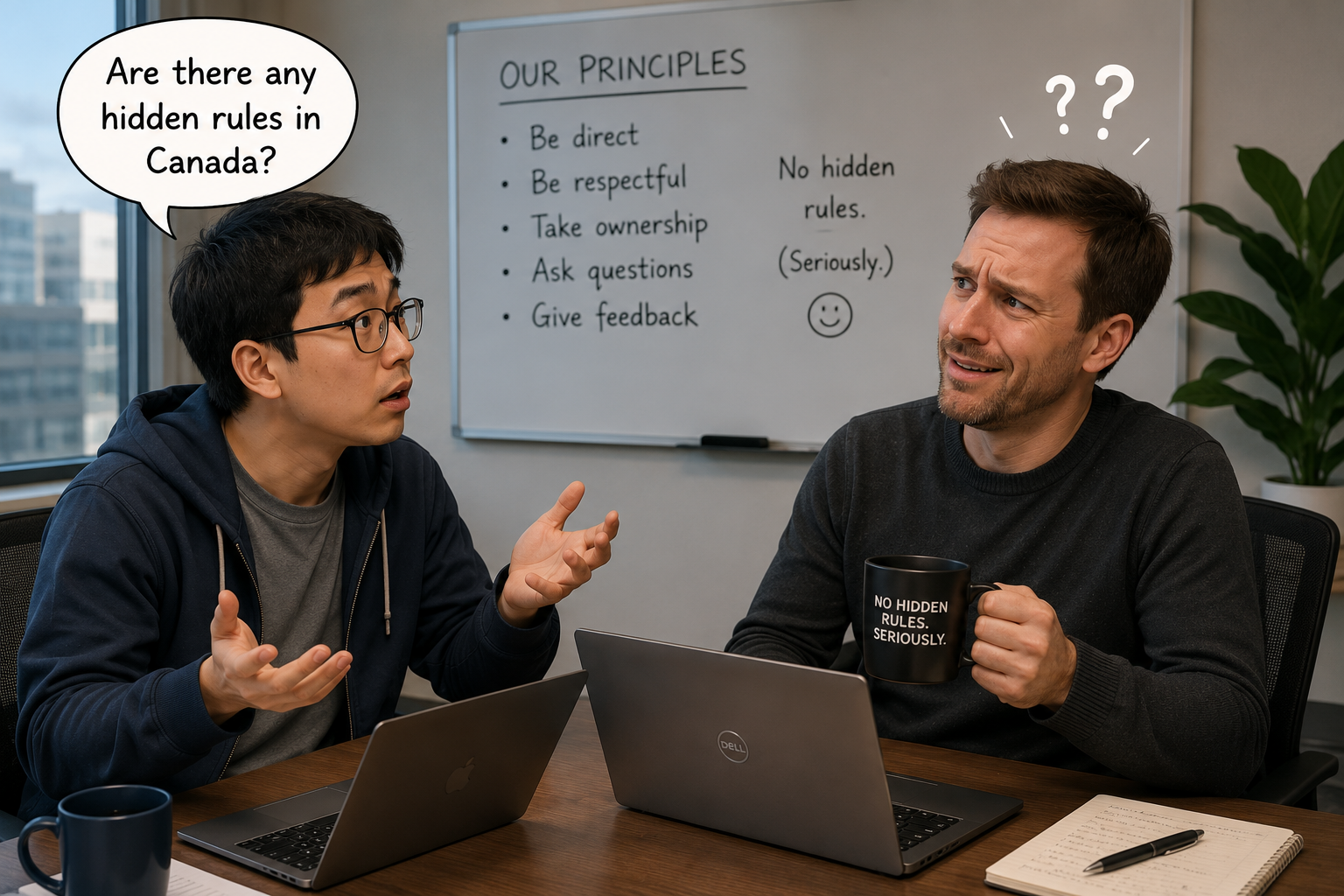
At one point, I asked my manager:
“Are there any hidden rules in Canada?”
He looked genuinely confused.
Then he explained that, on our team, important expectations were meant to be communicated directly.
It was a funny moment, but it also revealed the cultural gap between us.
I was searching for invisible danger.
He believed he had already explained what mattered.
Understanding the Code Was Not Enough
My manager patiently explained how the project worked: the different stages, the final delivery, the expectations, and the technical briefings I needed to prepare.
I understood the individual words.
I did not always understand their weight.
Technical communication was more important than I first realized. It was not enough to quietly complete the work. I needed to explain my thinking, present progress, confirm expectations, and show that I understood the wider project.
At the time, that felt close to the edge of my ability.
I was already spending so much mental energy translating English, reading social signals, and trying not to appear awkward. By the time someone discussed a briefing or a project expectation, my brain was sometimes too overloaded to recognize what mattered most.
During my first review cycle, I received feedback that was more difficult than I expected.
My manager explained that I was still learning how the team worked and had not yet completed a full year.
At first, I heard the feedback as a judgment.
Later, I understood it as a snapshot of someone still adapting to a new language, workplace, and culture.
When Every Joke Feels Like a Test
One day, I went to a restaurant with colleagues and ordered a steak.
I wondered whether I could ask for chopsticks.
A colleague joked, “Do you need chopsticks to eat a hamburger too?”
Today, I find that funny.
At the time, my mind immediately became busy.
Was he mocking me?
Did he think I was strange?
Was this a sign that I did not fit in?
That was one of the hardest parts of working in a new language and culture: every small interaction could become a mystery.
When you are already nervous, even a harmless joke can feel like a performance review.
Over time, I learned that teasing did not automatically mean hostility. Sometimes it meant the opposite. My colleagues felt comfortable enough to joke with me.
Not every sentence contained a hidden message.
The Great Vancouver Power-Nap Misunderstanding
Some differences were more practical.
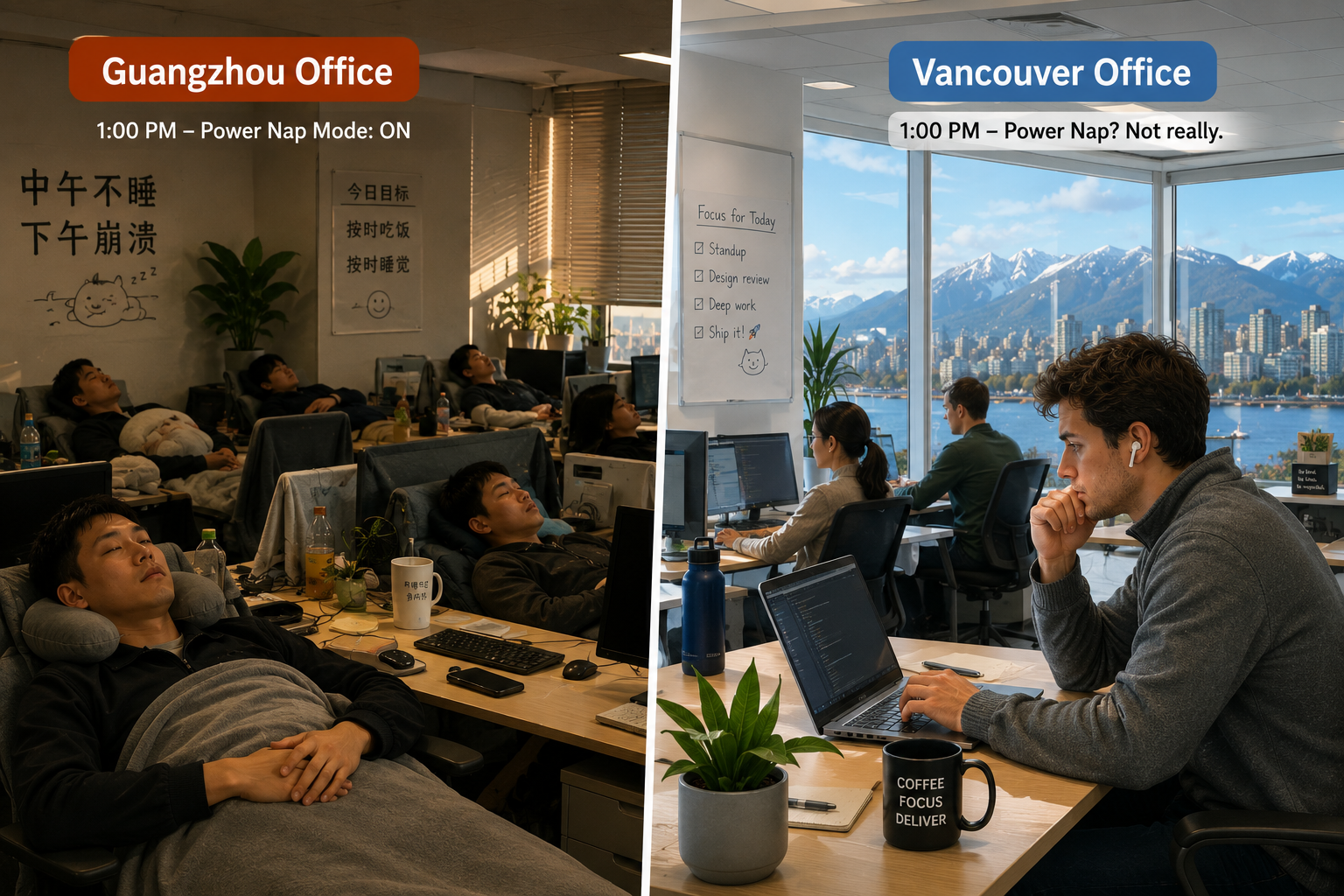
In Guangzhou, the post-lunch power nap was normal in many offices.
At around 1 p.m., people might dim the lights, lean back, rest at their desks, and recharge before continuing the day.
My body had memorized that rhythm.
So one afternoon in Vancouver, feeling extremely sleepy, I rested my head on my desk and tried to take a quick nap.
My manager walked past and said, “Hey.”
His expression suggested that this was not a familiar part of our office routine.
I had discovered another cultural difference in the traditional way: by doing the unexpected thing in public.
Neither approach was necessarily better. The rhythm was simply different.
From Constant Alertness to Ordinary Life
The biggest change did not happen in one dramatic moment.
It happened slowly.
My English improved. I spoke more. I understood my manager better. I became more comfortable asking what people expected instead of trying to guess.
I also stopped treating every mistake like a disaster.
Difficult feedback was not the end of my career.
A confused expression did not mean someone was angry.
A joke was not necessarily rejection.
An awkward lunch habit was not a cultural emergency.
Work became easier when I realized I did not need to remain in survival mode.
The hardest part was not learning how a Canadian software team worked.
It was learning that I could relax, ask questions, make mistakes, and still belong.
What I Would Tell My Younger Self
If I could speak to the version of myself who had just landed in Vancouver, I would not begin with career advice.
I would not tell him to improve his English faster or prepare better project briefings, even though those things mattered.
I would say:
Take it easy.
Be honest. Talk to your manager. Ask what they expect. Do not waste so much energy imagining danger that may not be there.
You will make awkward mistakes.
You may ask strange questions.
You may try to sleep at your desk while everyone else is still working.
It will be fine.
Learning to Enjoy Vancouver
Once I became less nervous, I could finally notice the life around the job.
Vancouver is beautiful in a quiet, comforting way.
There is the sea, the rain, the mountains, the summer sunshine, and the campfires in winter.
It is a place where life can feel soft around the edges.
For a long time, I was too alert to enjoy that softness.
Now, three years later, I understand that moving to Canada was not only a career transition.
It was a slow transition from fear to familiarity.
I did not become a different kind of software engineer overnight.
I became a less frightened version of myself.
TL;DR
- The technical career stayed familiar, but the workplace culture changed significantly.
- Clear communication and explicit expectations mattered more than I first understood.
- Many of my early mistakes came from language barriers, cultural differences, and anxiety.
- Feedback, jokes, and awkward moments became easier once I stopped assuming the worst.
- The real journey was not only from China to Canada. It was from constant nervousness to feeling at home.
Same Career, Different World
I am still a software engineer.
I still solve problems, write code, attend meetings, and occasionally misunderstand what someone means.
But I no longer feel that every interaction is a trap.
That may be the most important thing this experience has taught me.
Have you ever moved to a new country, company, or team and felt like you had to relearn a career you already knew? Share the moment when the new world finally started to feel normal.

Recent Comments